
Today, the healthcare industry is constantly evolving, so designing and building a modern and efficient medical office space plays a key role in the success of any physician or healthcare facility.
Furnishing a new medical office is one of the most important steps in the professional path of any doctor.
Choosing the right medical office furniture and equipment not only increases productivity but also creates a pleasant and reassuring experience for patients.
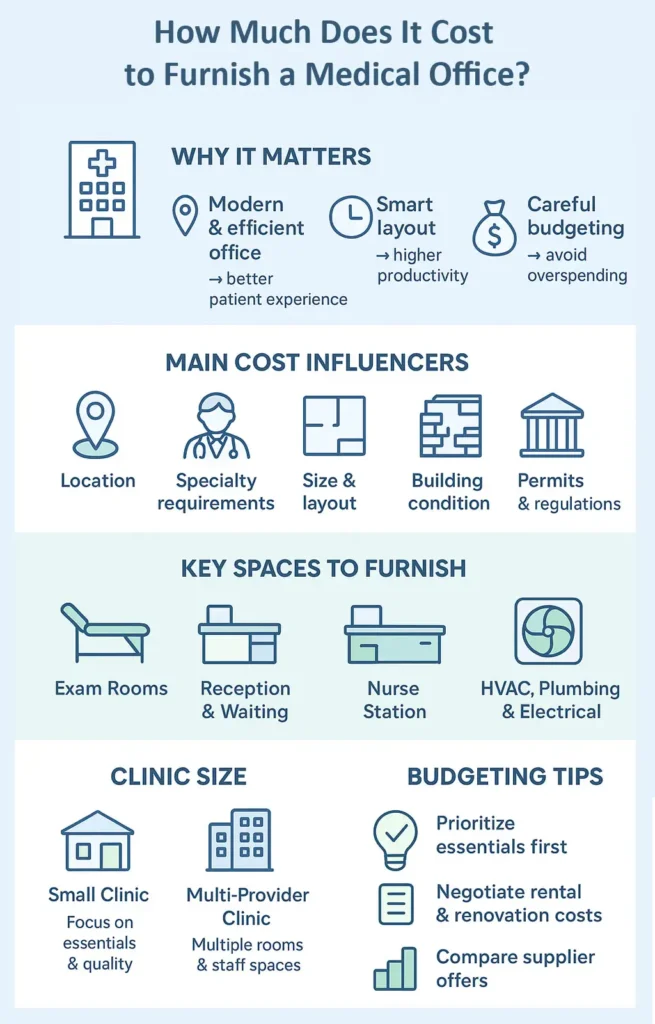
So you definitely want to know: how much does it cost to furnish a medical office?
Furnishing a medical office can range from $10 to $30 per square foot for basic furniture (desks, chairs, storage) and up to $1,200–$1,800 per square meter ($111–$167 per square foot) for the entire fitout, including finishes, fixtures, and non-medical furniture. The total cost depends on the office size, the level of finishes, specialty equipment, and whether you buy new or used items.
With over 30 years of experience in building and furnishing medical offices in Houston, Texas, ROSI Office Systems Inc. is a trusted partner to make your dream come true.
We understand that building a professional practice is not just about walls and equipment; it involves careful planning, smart budgeting, and purposeful design.
At ROSI, we make this path easier for you and will be with you at every stage, from design to implementation, so that your workspace reflects expertise, trust, and quality.
You Might Also Enjoy: Which Office Furniture Brands are Most Recommended for Quality and Comfort?
Main Factors Influencing Medical Office Furnishing Costs
- Location: The real estate market in Houston has a significant impact on costs.
Urban areas typically have higher construction costs than suburban areas.
Zoning regulations and access to urban infrastructure can also affect the final budget.
- Specialized requirements: Each medical specialty has its own characteristics and infrastructure.
For example, the equipment in an eye clinic is completely different from that in a pediatric office.
Special plumbing, a dedicated ventilation system, or radiation shielding are among the factors that can increase construction costs.
- Size and layout of the space: The size of the office directly affects the cost of construction.
The larger the space and the more complex the interior design, such as multiple examination rooms, waiting areas, or specialized spaces, the more materials and labor are required.
- Condition and age of the building: The current conditions of the chosen space have a direct impact on the medical office furnishing costs. Renovating a raw space requires more extensive work than a ready-made medical office.
Also, older buildings may require more renovation to comply with new building standards.
- Compliance with regulations and permits: Navigating the complex path of building codes and health standards requires precision and experience.
- Obtaining the necessary permits and complying with legal requirements may affect the design, type of materials, and ultimately the overall cost of the project.
A Breakdown of How Much It Costs to Furnish a Medical Office
You Might Also Enjoy: Which Brands Offer the Best Modular Dividers for Quiet Offices?
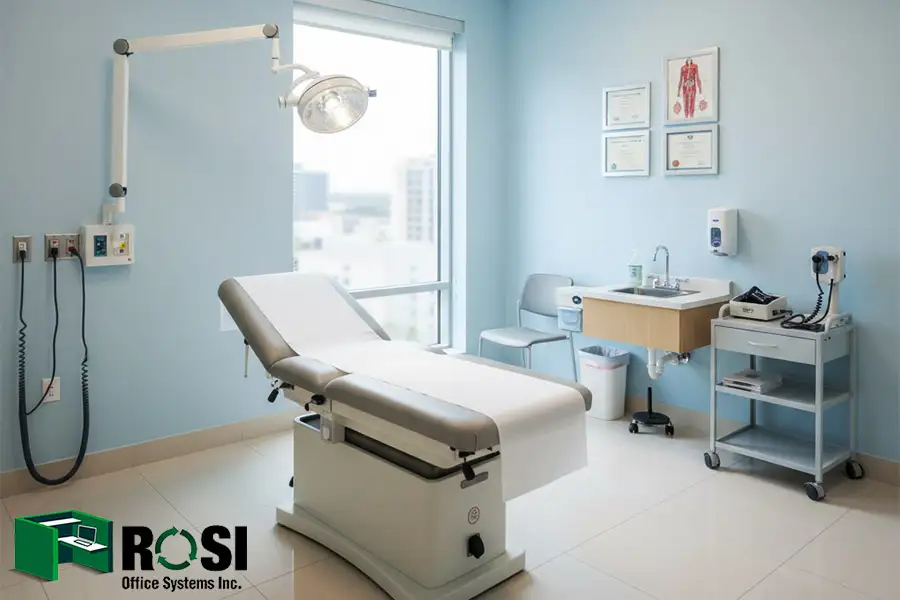
Exam Rooms
Setting up any examination room in a medical office or clinic requires a set of standard equipment, the costs of which will vary depending on the brand, size, and quality.
Here are the main details and price ranges for each section.
Complete examination room packages usually include all the basic equipment needed for any examination room:
- Examination table: These beds range in price from $1,900 to $3,500 per bed, depending on the seller and configuration.
The price difference depends on factors such as height adjustment features, drawers, foam quality, and covering material (Vinyl).
- Privacy Curtains: Curtains used to separate different areas or create privacy around the bed.
The price of each panel (piece of curtain) is calculated separately, and the mounting rails or fasteners (Track/Hardware) are usually calculated separately and based on the perimeter length.
You will pay approximately $230 to $270 per curtain panel.
The cost of installation or rails varies and is calculated depending on the design of the room (e.g., L- or U-shaped).
- Wall and floor cabinets: These are generally mounted on the wall and used to store supplies, medications, equipment, or patient records.
There is also a type of filing cabinet that sits on the floor and can have a work surface on it.
In office furniture stores, cabinets for offices have also been seen at prices ranging from $189 to $512.
- Doctor’s chair (stool): These office chairs are designed for the doctor or nurse to be comfortable and at the right height when examining a patient.
Simple, backless models are cheaper, but models with a back or antibacterial coating (Healthcare-grade vinyl) are more expensive.
About $150 to $800 per chair, depending on design and material.
- Patient’s chair: A chair that a patient sits in during an examination or consultation.
Its approximate price is between $150 and $600.
- Trash can and accessories: Their use is to collect general or medical waste in the examination room and maintain hygiene.
The price of these buckets varies from $30 to $250, depending on the type.
Total Cost: Between $2,600 and $5,400 per room (depending on brand and size of equipment).
Examples of these packages are provided by companies like ROSI, which are supplied complete and ready to install.
You Might Also Enjoy: What Are the Top Office Cubicle Brands in Modular Interiors?
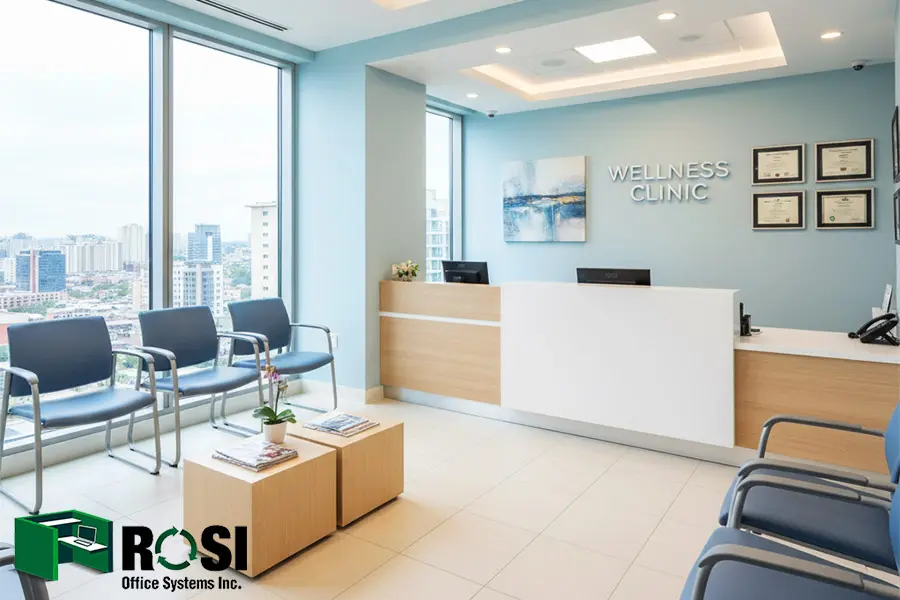
Reception and Waiting
- Reception desk: The reception desk is the first point of contact patients have with the office or clinic.
These office desks usually include drawers, shelves, and adequate space for computers and office equipment.
The typical range for this piece of office furniture is $1,600–3,400.
- Waiting chairs: The seating area for patients while waiting should be comfortable, durable, and hygienic.
Therefore, they must have a design that is resistant to continuous use.
Some models have handles, and some do not.
The approximate price is between $200 –600 per chair.
For the waiting area, using comfortable, antibacterial, and highly durable chairs increases patient satisfaction and better the management of the waiting area.
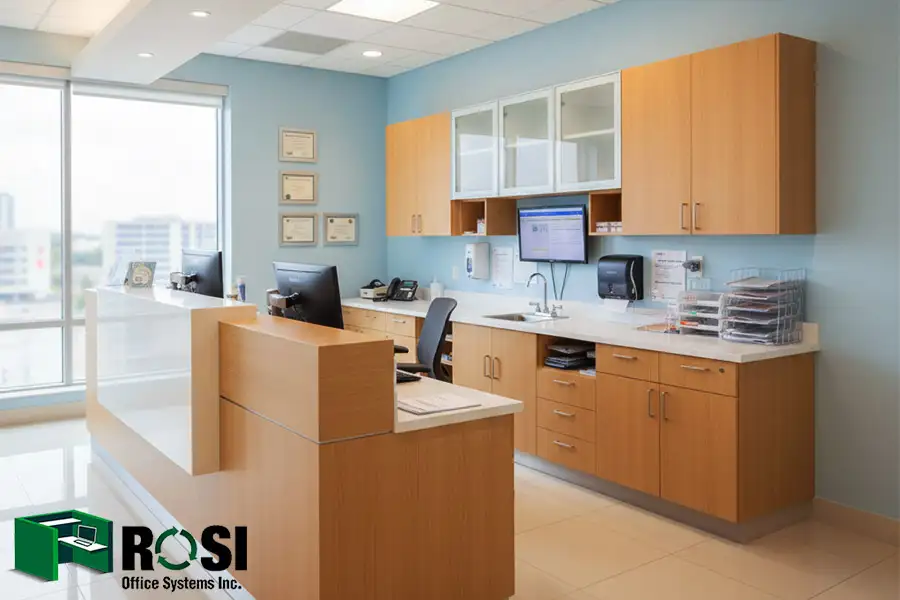
Nurse Station and Casework
The nursing station is the main location for nursing staff to record patient information, prepare equipment, and coordinate between departments.
It includes workbenches, shelves, cabinets, and sometimes a sink and dedicated storage spaces.
These stations are usually designed based on project needs and vary in length, height, material, and internal equipment (e.g., sink, drawer, shelf).
Their coating and material are usually antibacterial laminates or moisture- and impact-resistant coatings for hygiene and high durability.
An approximate price of $1,500 to $4,000 for a medium-sized nursing station can be expected in 2026.
Construction costs
1. Interior finishing (walls, flooring, ceiling)
The choice of materials for walls, floors, and ceilings has a significant impact on costs.
Here are the approximate ranges for 2026:
- Basic painted drywall: About $2.5 to $5.5 per square foot.
- Soundproof or specially constructed walls: About $11 to $22 and up per square foot.
- Vinyl Composite Flooring and Tile (VCT): About $3.5 to $9 per square foot.
- Epoxy flooring for healthcare facilities: around $9 to $16.5 and up per square foot.
- Typical Drop Ceilings: About $3.5 to $5.5 per square foot.
- Acoustic or feature ceilings: About $5.5 to $11 and up per square foot.
2. Plumbing and Electrical Work
The complexity of plumbing and electrical systems depends directly on the needs of your office or clinic.
Installing special equipment such as sinks, radiology machines, or other specialized equipment increases costs.
Approximate price is around $20 to $55 per square foot.
Consider the additional costs of installing specialized equipment, such as imaging devices or advanced water and sewage systems.
3. HVAC Installation
An efficient HVAC system is vital for patient comfort and maintaining a sterile environment.
The size and type of system required will determine the final cost.
The approximate price of basic systems is $10 to $22 per square foot.
Complex and advanced systems with precise temperature and humidity control will cost more.
4. Cabinetry and Fixtures
Medical cabinets, countertops, and specialized laboratory equipment make up a significant portion of the costs.
Choosing between custom and pre-built cabinets also has a direct impact on price.
The approximate price of standard medical cabinets and countertops is $150 to $400 per square foot.
You Might Also Enjoy: TOP 10 Business Office Furniture You Must See
How Much Does It Cost to Furnish a Medical Office in Different Sizes
The size and scale of the practice have the greatest impact on costs.
1. Small Clinics
A small clinic with just one or two examination rooms can usually be equipped at a significant fraction of the cost of a large facility.
Small spaces offer more flexibility in design, and the owner can focus on quality, rather than quantity, by investing in durable furniture for a limited number of rooms.
Small medical office furniture and equipment budget example:
- Approximate area: 1,500 square feet
- Number of examination rooms: 3
- Number of waiting chairs: 12
- Number of doctors: 2
Estimated Costs:
- Exam rooms: 3 x $3,500–4,800 → $10,500–14,400
- Admission and waiting area: $3,600–13,000
- Physician workspaces (2 people): $1,800–5,000
- Nursing station/casework: $3,000–10,000
Approximate Total Clinic Furniture: $19,000–42,000
Average about $30,000
Features:
- Small spaces allow for a focus on quality.
- The owner can invest in durable, medical-grade furniture in a limited number of rooms.
2. Multi-Provider Clinic
- Approximate area: 3,500 square feet
- Number of examination rooms: 8
- Number of waiting chairs: 24
- Number of doctors: 5
Estimated Costs:
- Exam rooms: 8 x $3,500–4,800 → $28,000–38,000
- Admission and waiting area: $6,000–18,000
- Physician workspaces (5 people): $4,500–12,500
- Nursing station/casework: $10,000–30,000
Approximate total: $48,000–98,000
Average around $70,000
Features:
- Large centers should equip multiple examination rooms, waiting areas, and staff spaces to effectively manage patient flow.
- Specialized equipment and a variety of furniture may be required for different medical fields.
- Although the initial cost is higher, it is more economical to purchase equipment and medical furniture in bulk and on a large scale.
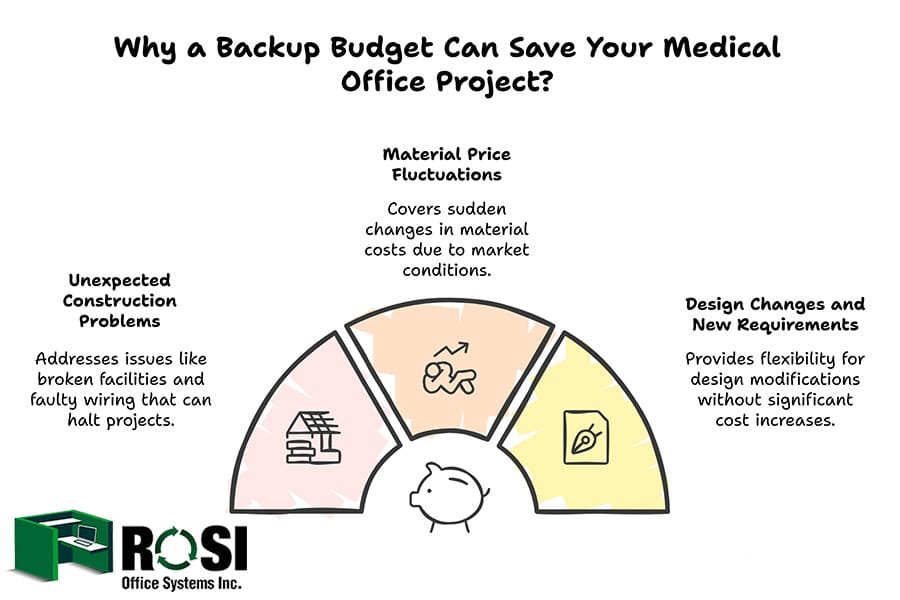
Why a Backup Budget Can Save Your Medical Office Project?
In any medical office construction or renovation project, even if everything is carefully planned, there is always the possibility of unexpected events occurring.
For this reason, having a contingency budget is one of the smartest financial decisions in the construction process.
With over 30 years of experience implementing healthcare projects in Houston, ROSI believes that allocating a portion of the overall budget to cover unforeseen circumstances can make the difference between a successful project and a costly and stressful one.
Why do you need a backup budget for furnishing a medical office?
- Unexpected problems during construction: During construction, issues such as broken old facilities, damaged wiring, or faulty plumbing may become apparent.
Without a backup budget, such problems can halt the entire project or cause significant cost increases.
- Sudden changes in material prices: The prices of construction equipment and materials often fluctuate due to market conditions or supply shortages.
Having a financial reserve can prevent project stalling and financial pressure in these situations.
- Changes in design or new requirements: During the course of the project, you may decide to change the layout of rooms, the color scheme, or the equipment.
Having a forecast budget provides the flexibility needed for these changes without significantly increasing the overall cost of the project.
According to current industry standards for furnishing a medical office:
For simple or low-risk projects, around 5% of the total budget is sufficient.
For more complex projects or renovations of older buildings, it is recommended to allocate 10% or more of the total budget to this section.
Budgeting Tips and Strategies to Furnish a Medical Office
Proper financial planning plays a very important role in furnishing a modern and professional medical office.
With over 30 years of experience in designing and constructing medical offices, ROSI Office Systems Inc. helps you advance your project with a controlled budget and without unnecessary expenses.
1. Prioritizing Expenses
First of all, distinguish between necessary and unnecessary expenses.
Equipping examination rooms, cabinets, and patient chairs is a priority.
Design upgrades or the use of luxury materials can be done at a later stage as the medical office grows.
2. Professional Negotiation in Space Rental
If your medical office is rented, carefully review and negotiate the terms of the lease agreement.
Tips such as allocating funds for renovations, sharing maintenance costs, and discounting rent can result in significant savings.
3. Receive and Compare Multiple Offers
Never settle for the first offer made.
Inquire with several reputable contractors and suppliers for construction, equipment, and medical furniture.
Comparing offers allows you to choose the best quality at the most affordable price.
4. A Long-Term View of Costs
Don’t settle for the initial price.
Choosing durable materials and easy-to-maintain medical equipment will reduce repair and replacement costs over time.
Decisions made today are your secure investment for tomorrow.
By following these strategies, you can manage the costs of furnishing a medical office, avoid unnecessary payments, and build a clinic that is both efficient, comfortable, and long-lasting.
Our team at ROSI is ready to accompany you through all stages of the project, from budget planning to construction completion, ensuring that your dream becomes a reality.
Conclusion
Furnishing a successful medical office requires a deep understanding of the costs and details of the project, in addition to paying attention to the design and limited appearance.
From construction to permits and professional services, it’s key to moving a project forward without a hitch.
With proper budget management and careful planning, you can ensure that your project will be successful both in terms of quality and financial performance.
With extensive experience in building medical offices in the Houston, Texas area, our team is ready to guide you through every step of the medical office furnishing process and make your dream a reality.
Contact us today and take the first step towards managing your budget and building your professional medical office with a free consultation.
Your project is in safe, experienced hands, and now it’s time to turn your ideas into reality.

John Ofield is a recognized expert in the office furniture and office cubicle industry in Houston, TX, with over 40 years of experience. As the founder of ROSI Office Systems, he specializes in furniture space planning, custom cubicle designs, modern office chairs and tables, and high-quality commercial furniture. John’s expertise helps businesses enhance productivity and collaboration. He is also dedicated to mentoring entrepreneurs and redefining workspaces to inspire success.