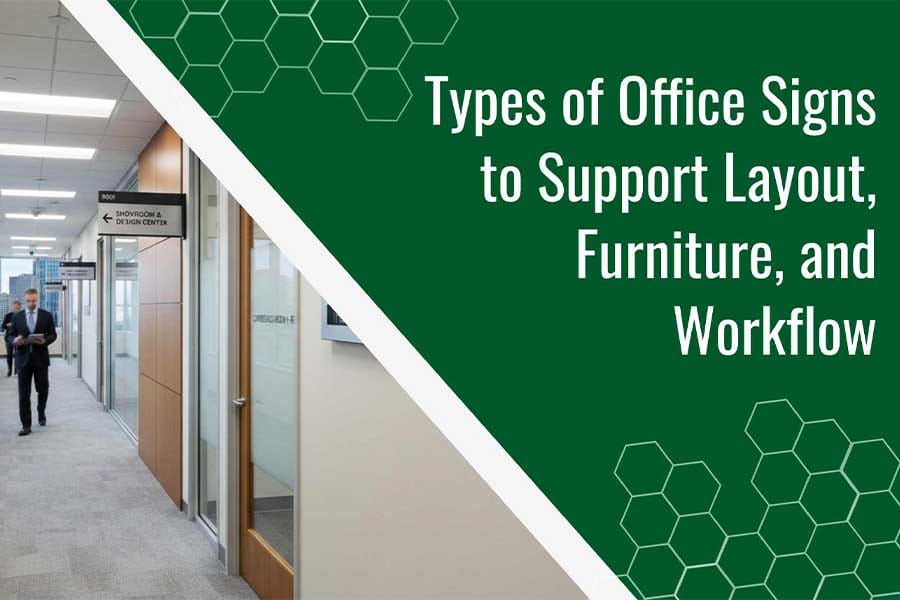
Discover the types of signage Houston businesses use to streamline office workflows and complement modern office furniture.
In large offices, especially in cities like Houston, using different types of office signs helps keep the space organized and makes work flow more smoothly. When you choose signs carefully, it is easier for people to get around, and both employees and clients have a better experience.

Why Office Signage Matters in Houston Workspaces
Offices in Houston are often not simple.
The spaces are large, the departments are numerous, and the traffic is always moving. In such an environment, the right use of different types of office signs is not just for beauty; it is for functionality.
When signs are designed and placed correctly, the space becomes understandable. People know where to go, where not to stand, and which way to go. This directly affects the team’s focus and the pace of work.
Office signs are essentially part of the experience of using the space. From the employee’s perspective, from the guest’s perspective, and even from the customer’s perspective.
Here we are faced with different types of signs, each of which has a specific role; from guidance to defining the boundaries of spaces.
In offices where signs are ignored, there is usually more confusion. Too many questions are asked. Paths are cut off. But when the right types of signage are chosen, the space speaks for itself.
Navigating Large and Multi-Department Offices
In multi-department offices, navigation is a major challenge.
Corridors, departments, meeting rooms, and common areas can quickly become a problem if they aren’t clear.
This is where office signs really come into their own. Directional signs, department names, arrows, and floor signs are all examples of signs that make movement easier.
These signs help:
- Reduce people’s misdirection
- Reduce disruption to teams
- Make more efficient use of space
In Houston’s large buildings, the difference is palpable. Without signs, the space feels cramped. With signs, the space becomes usable.
Connecting Signage to Layout and Furniture Planning
Signage is most effective when it is in harmony with the layout. Furniture creates a path. Signage explains the path.
When desks, rooms, and common areas are thoughtfully arranged, using different signage helps to make that logic visible. This is where the difference between ordinary and great signage becomes clear.
Good signs don’t clutter the space; they show the way, and they make the office both functional and understandable.
You Might Also Enjoy: The Best Materials for Corporate Office Furniture in 2026

Wayfinding and Directional Signs
Guiding Movement Through Office Layouts
In large offices, especially in Houston’s multi-story buildings, it can be really difficult to find your way around without guidance.
Hallway signs, arrows, reception guides, and floor markings help make the space feel natural and seamless. They make it clear where to get to desks, conference rooms, and common areas.
When wayfinding is well-designed, people are less likely to get lost, and their movements are more orderly. The result? Better focus and less disruption to their daily work.
Accessibility and Visual Hierarchy
Navigation signs need to be easy to see and understand. Easy-to-read fonts, simple icons, good color contrast, and the right placement all work together. This isn’t just for people with special needs; it’s for everyone.
In Houston’s large, multi-story offices, visual hierarchy helps the eye first see the most important message. When accessibility is considered, the space becomes more user-friendly, making it easier for everyone to navigate.

You Might Also Enjoy: Ultimate Guide to Office Cubicles for Efficient Workspaces
Room Identification and Department Signs
Defining Functional Spaces
When you walk into an office, the first thing you need to know is how each space is used. Room door signs, meeting room labels, and department names are among the simplest yet most important types of office signs.
They clearly indicate what each space is designed for. A meeting room is different from a workspace. The finance department is not the same as the human resources department.
Having these different signs allows employees and visitors to quickly find their way without asking. This means more order and better use of space.
Supporting Meeting Flow and Daily Operations
Identification signs don’t just provide information. They support the daily workflow. When rooms are properly identified, interruptions are reduced. No one walks into the wrong meeting. Schedules don’t get mixed up.
These signs work alongside office furniture, such as desks, conference room tables, and collaboration spaces. The right combination of layout and types of signage makes an office run more smoothly and predictably. That’s exactly what sets great signage apart from ordinary signage.
Safety and Compliance Signage in Office Environments
Essential Safety and Emergency Signage
Office safety signs are no joke. Emergency exits, capacity limits, no-go areas, and safety warnings need to be readily visible and understood. This type of different signage isn’t for beauty; it’s for keeping people safe.
In an emergency, no one has time to think. The message needs to be delivered quickly and clearly.
Aligning Safety Signs with Office Layout
The location of safety signs is just as important as the signs themselves. If it is behind a cupboard, next to an office desk, or out of the way of traffic, it is practically useless. The furniture arrangement should not obscure the safety message.
In large Houston offices, coordination between the space plan and office signs is even more important. The sign should be seen in the natural direction of movement. Clear. Unobstructed. This practical approach is the basis for compliance with standards and real safety.

Branding and Interior Visual Signage
Visual Branding Inside Office Environments
Branding doesn’t just happen outside the building.
Inside the office, the brand identity is seen and experienced every day. Wall logos, environmental graphics, decals, and visual elements help the space speak. This type of office signage helps employees and visitors subconsciously connect with the brand.
In Houston offices, where spaces are often open and spacious, these visual cues play a key role in defining the space. When done right, they convey the brand message without being overwhelming and help create a cohesive environment.
Balancing Branding with Furniture and Finishes
Good branding is balanced.
Signs shouldn’t compete with furniture or make the space look cluttered. Colors, materials, and finishes should coordinate. A successful design creates a balance between graphics and layout.
This is where signage that Houston businesses use can play a key role through the strategic use of office signage solutions in Houston.
Business signage, when placed next to modern furniture and appropriate materials, is not only not intrusive, but also completes the space.
You Might Also Enjoy: How Much Does It Cost to Furnish a Medical Office?
Informational and Policy Signs
Communicating Office Policies Clearly
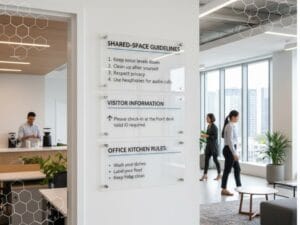
In every office, there are small rules that can become deal breakers if they aren’t clearly stated. This is where informative types of office signs come in handy.
Office rules signs, common area guidelines, and visitor information help everyone know what’s expected without asking.
These are examples of signs that directly impact everyday work. They have a direct impact on daily work. Clear policies help communication run smoothly and make teamwork easier.
This kind of signage is mainly about keeping things organized and making sure everyone understands each other.
Strategic Placement for Visibility
The location of a sign determines whether it’s seen or ignored.
Consider that near the reception desk, next to the break room, or around shared equipment are the best spots.
This is where the decision is made. Well-designed office signs, when installed correctly, convey the message at the right time and ensure compliance with the rules.
How Office Furniture and Signage Work Together
Furniture as the Physical Framework
Furniture layouts define the flow of movement.
Desk clusters, meeting spaces, and collaboration zones tell people where to work and where to take a break.
This physical structure is the foundation of behavior.
Without it, even the best signs are not fully effective.
In large offices, this coordination keeps the space predictable and usable.
Signage as Visual Reinforcement
Signs serve a confirming role. They complete what the space has started.
With different types of signs, you can clarify paths, reduce ambiguity, and move work forward more quickly.
When this coordination is done right, the result is great signage that works alongside the furniture, not separately. This systemic approach both increases productivity and improves the office experience.
Conclusion
The right combination of office signage, layout, and furniture creates a cohesive system.
From wayfinding and safety to branding and internal rules, the right signage reduces confusion, increases productivity, and improves the work experience for everyone.

John Ofield is a recognized expert in the office furniture and office cubicle industry in Houston, TX, with over 40 years of experience. As the founder of ROSI Office Systems, he specializes in furniture space planning, custom cubicle designs, modern office chairs and tables, and high-quality commercial furniture. John’s expertise helps businesses enhance productivity and collaboration. He is also dedicated to mentoring entrepreneurs and redefining workspaces to inspire success.