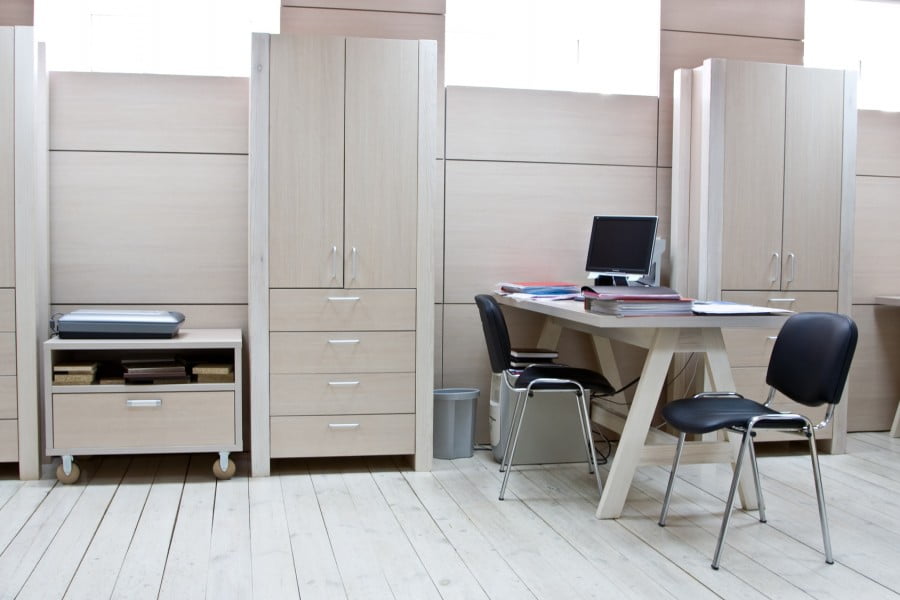
Have you ever tried to work effectively surrounded by chaos?
I’m not talking about audible noise you can hear; I’m talking about the noise your messy desk makes when it’s cluttered with junk!
Whether you work at home or in an office, keeping your office desk, office furniture, and surrounding office space organized is vital to the success of your career.
An organized office space not only makes a good first impression, but it’s also much easier to stay on top of all your work when it’s not buried under files or yesterday’s lunch container.
Now the question is: how to organize your office?
Organize your office by decluttering your desk, keeping only daily essentials within reach, and creating clear zones for work, storage, and reference materials. Use vertical storage, drawer dividers, and cable management to reduce clutter and maintain a clean, productive workspace.
Along with establishing a sense of structure and order, studies show people are better able to concentrate and work more efficiently in clutter-free environments.
You can become much more efficient and productive by making just a few simple changes.
Whether you’re organizing an entire office or simply trying to organize your office desk more efficiently, a clear system makes all the difference.
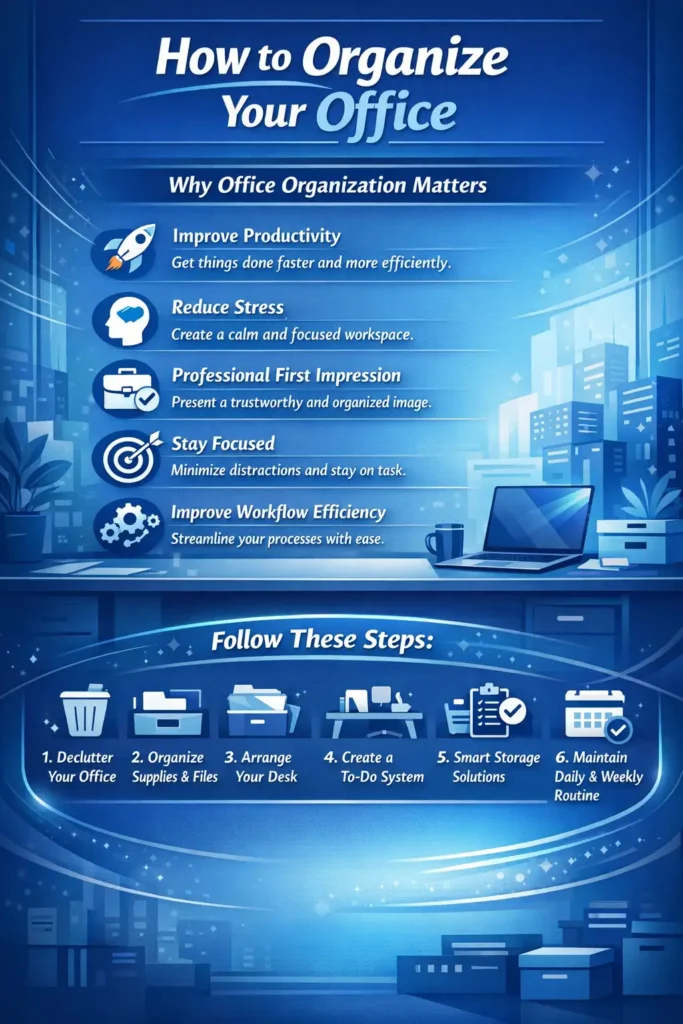
Why Office Organization Matters
- Improve Productivity: When you learn how to organize your office desk or even manage your entire workspace, you’ll spend less time searching for documents and supplies.
An organized office desk helps you get things done faster and more efficiently.
- Reduce Stress: A cluttered desk creates a kind of mental noise.
The office organizing process makes your workspace calmer and allows you to work without mental pressure.
- Professional First Impression: An organized office not only affects your performance but also creates a professional and trustworthy image of you.
When someone enters your workspace, a tidy office shows that you know how to manage your organized office.
- Stay Focused: If you know how to organize an office in principle, environmental distractions will be reduced.
An organized office desk keeps you focused on your core tasks.
- Improve Workflow Efficiency: Organizing an office is about building a system that makes the process of completing projects smoother.
When you know how to organize my office effectively, things will go more smoothly and without wasting time.
You Might Also Enjoy: Types of Signage Houston Businesses Use to Support Furniture & Workflow
Step 1: Declutter Your Office
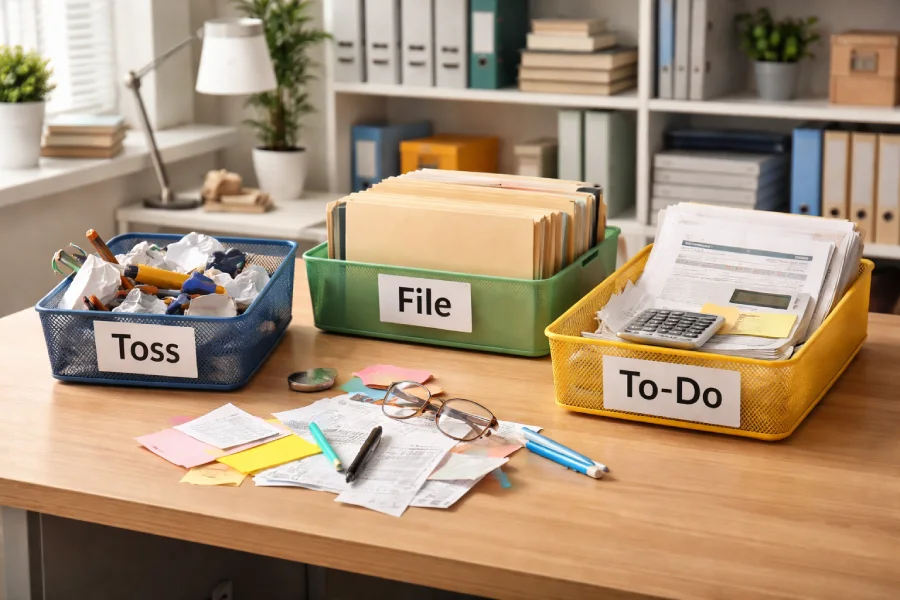
So, the first thing you need to do to start your organization transformation is create three piles.
“Toss”, “File”, and “To-Do”. Now, you are really going to have to commit to letting things go.
As you are going through your desk, think about whether or not you needed something in the past year.
Start with the stuff on top of your office desk.
Do you need 40 pens jammed into your pen holder?
What about all of those files in your desk organizer?
After clearing off your office desk, go through your drawers, filing cabinets, binders, and shelves.
Don’t forget to go through files left behind by your predecessor; you’ll need to make space for your own filing system.
The Toss, File, To-Do System
If you find an expense receipt, put it in the to-do folder.
An old report from last year’s project? File it.
You might also find a marker that no longer writes or a notepad with an incomprehensible number. Toss it.
The goal of doing these things is to keep your desk clutter-free at all times.
Eventually, you should get to the point where every piece of paper that comes across your desk has an immediate assignment: either tossed, filed, or added to your to-do list.
Step 2: Organize Office Supplies and Files
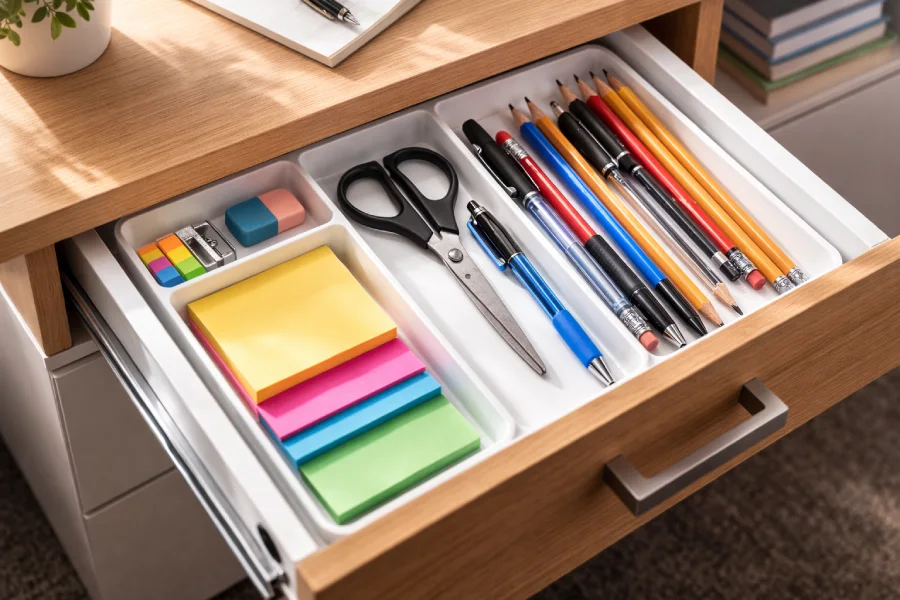
Desk Drawer Organization
The next step is to choose a simple system for organizing your office supplies.
Do you want the top drawer of your desk to be reserved for pens, pencils, and other basic office supplies?
If you have a sizable office desk, you can opt to get the desktop organizers to help you keep your office supplies in place.
If your desk is of modest size, hide away your office supplies in a drawer.
Use one of those handy drawer organizers to keep everything in its place. Next, tackle your pile of files and papers.
Filing System Setup
Now it’s time to deal with the files and sheets.
Only keep the files that you reference frequently in the hanging file cabinet nearest you.
All other archived materials can be placed in plastic bins or boxes and placed in the storage closet.
Put all related items into the box, label it, and store it.
Labeling System
Labeling is crucial for your filing system to be truly efficient.
At this point, a label maker can be your best friend!
Clear and precise labels will help you access documents more quickly in the future and keep your office organized.
You Might Also Enjoy: The Best Materials for Corporate Office Furniture in 2026
Step 3: How to Organize Your Office Desk Efficiently
If you want to know how to organize your office desk effectively, you should start from the simplest point: the surface of the desk.
Start with the stuff on top of your office desk.
Everything on your desk should have a specific reason for being there.
If you haven’t used a device in a long time, delete it or put it in a suitable place.
The goal is to keep your desk clutter-free at all times.
An organized office desk helps you stay more focused and work faster.
Your ultimate goal will be to deal with every piece of paper that crosses your desk immediately.
Trash it, file it, or put it in your to-do inbox.
Don’t let papers pile up.
To keep your desk tidy, follow these simple tips:
- Keep only daily-use items on the office table.
- Store reference documents and folders vertically to keep horizontal desk space free.
- At the end of each workday, take a few minutes to reset your desk.
By following these simple principles, the process of organizing your office desk will become a daily habit for you, rather than a large, time-consuming project.
Step 4: Create a To-Do Management System
Look at your to-do pile.
This is where you should be thinking about efforts to organize yourself long-term.
Create a system that will keep you on-task and organized effortlessly.
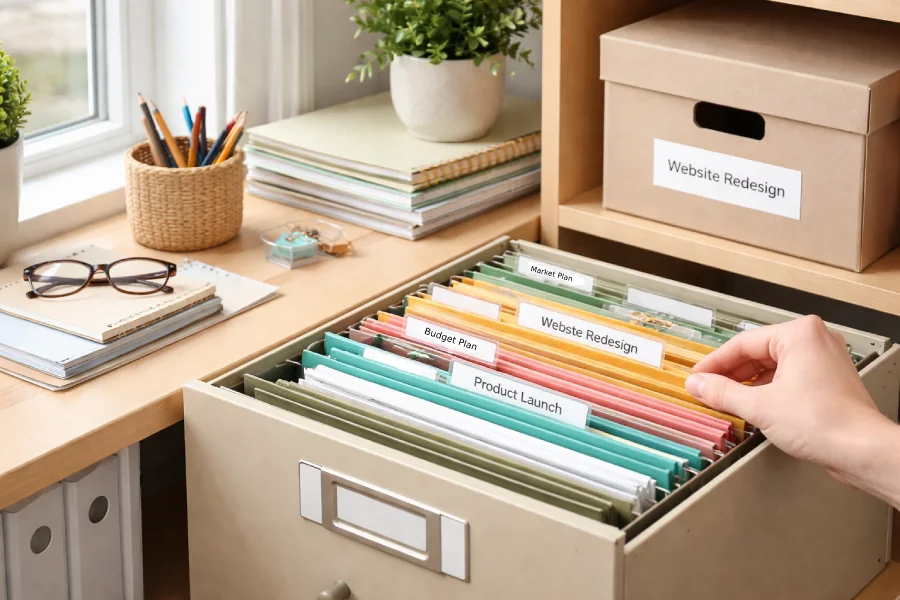
Start by creating file folders for each project you are currently working on.
Place these where they can be easily accessed nearest you in a hanging file.
As you finish each project, clean out anything extraneous in the folder, leaving only the important information.
Place all related materials to the project in a box, label it, and store it away.
Complete the next project, rinse and repeat.
Step 5: Smart Storage for Long-Term Organization
Now, you’ll find that even after this exercise, you’ll have a pile of stuff that you are not ready to part with, but does not belong anywhere.
Save one of your bottom drawers for all of the junk that will not fit neatly into an organizer or hanging file.
It’s out of sight and out of mind.
It doesn’t make much noise when it’s tucked neatly away in a drawer you can close.
But don’t let it get out of control!
You Might Also Enjoy: Ultimate Guide to Office Cubicles for Efficient Workspaces
Step 6: Maintain Your Organized Office (Daily & Weekly Routine)
An organized office is key to an effective workplace.
It seems like such a simple thing, but the fact is that when we take the time to organize our office, we become more efficient.
Make a habit at the end of each day to tidy the top of your desk, file any papers, and even organize a drawer that’s gotten out of hand again.
This way, you won’t get stuck with a huge cleanup project every few weeks.
You’ll find that your organized desk will actually give you more time to focus on the challenging tasks, like organizing your endless stream of email.
A 5-minute reset at the end of each day prevents clutter from building up again.
Conclusion
Organizing your office and learning how to organize your office desk in a systematic way can have a significant impact on your daily performance.
To organize your office desk, all you need to do is have a specific system for organizing, archiving, and managing tasks, and implement it consistently.
An organized office desk not only looks more professional, but also increases your focus and prevents stress caused by clutter.
When the process of organizing an office becomes a daily habit, productivity increases, and less time is spent searching for documents or supplies.
Ultimately, an organized office isn’t just about being tidy; it’s about creating a space that supports your productivity, focus, and long-term success.
If you know how to organize an office in a systematic way, your work environment will become a tool for progress, not a distraction.
FAQs
1. What is the best way to organize a small office desk?
The best way to organize a small office desk is to keep only daily-use essentials on the surface and store everything else in drawers or vertical organizers.
Declutter regularly, use drawer dividers, and file papers immediately.
A minimalist setup helps create an organized office desk without taking up extra space.
2. How often should I declutter my office?
You should declutter your office desk daily with a quick reset and do a deeper office organizing session once a month.
Removing unnecessary papers and unused supplies regularly prevents clutter from building up and helps maintain an organized office that supports productivity.
3. What supplies help organize an office efficiently?
Essential supplies for organizing an office include drawer organizers, hanging file folders, storage boxes, vertical file holders, and a label maker.
These tools help you organize office documents, reduce clutter, and maintain an organized office desk with a clear and simple filing system.

John Ofield is a recognized expert in the office furniture and office cubicle industry in Houston, TX, with over 40 years of experience. As the founder of ROSI Office Systems, he specializes in furniture space planning, custom cubicle designs, modern office chairs and tables, and high-quality commercial furniture. John’s expertise helps businesses enhance productivity and collaboration. He is also dedicated to mentoring entrepreneurs and redefining workspaces to inspire success.