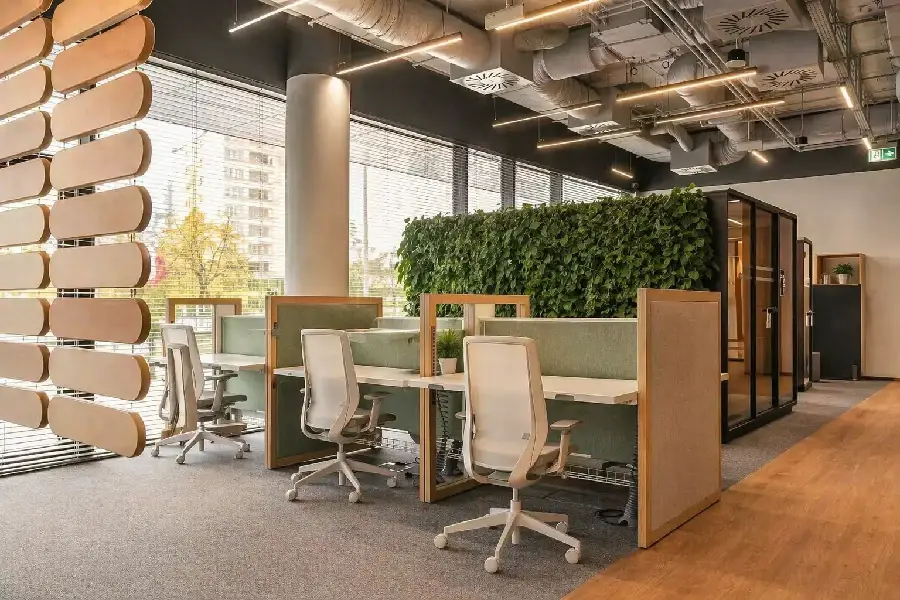
Neither private office nor open office is the best choice for everyone.
Each works well in a specific situation.
If focus and privacy are important, a private office is best.
If teamwork and lower cost are important, open space is a better choice.
For most companies, the real answer is a hybrid work model.
This means they have both a quiet space for deep work and an open space for interaction.
This model usually strikes a better balance between efficiency, privacy, and cost.
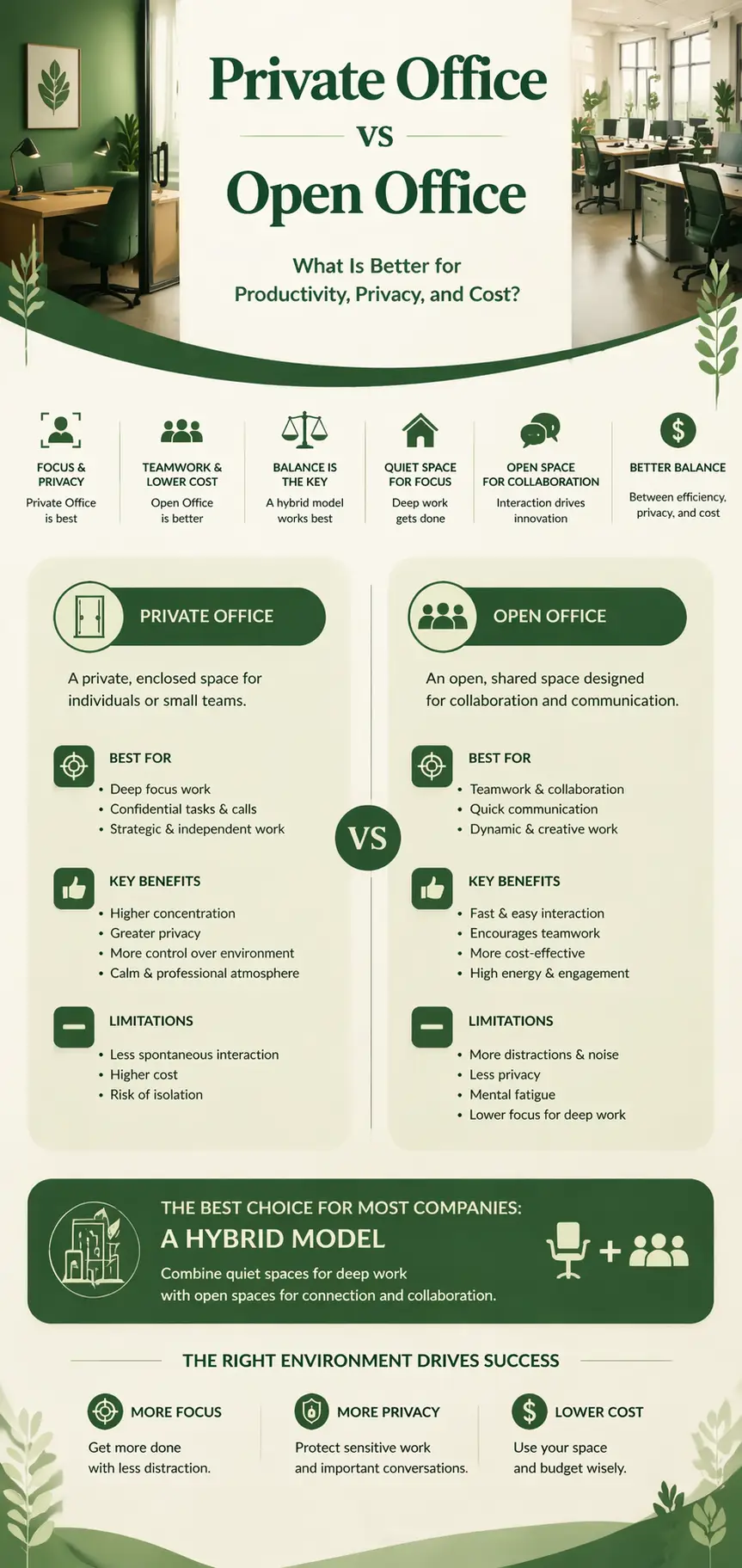
Private Office vs Open Office: Key Differences at a Glance
| Criteria | Private Office | Open Office |
|---|---|---|
| Privacy | Very high. Enclosed and controlled space | Low. Easy access and visibility |
| Noise | Low. Minimal distractions | High. Constant noise and movement |
| Collaboration | More limited. Requires coordination | High. Fast and direct interaction |
| Cost | Higher. More space per person | Lower. More efficient use of space |
| Flexibility | Lower. Harder to reconfigure | Higher. Easy to adapt and rearrange |
| Scalability | More difficult. Expanding space is costly | Easier. Teams can grow quickly |
| Client-facing professionalism | High. Suitable for formal meetings | Moderate. Less formal appearance |
| Suitability for hybrid teams | Good for focused work, but limited interaction | Good for collaboration, but needs quiet zones |
You Might Also Enjoy: Is Coworking Space Furniture More Than Just a Desk? A Practical Guide to Better Shared Workspaces
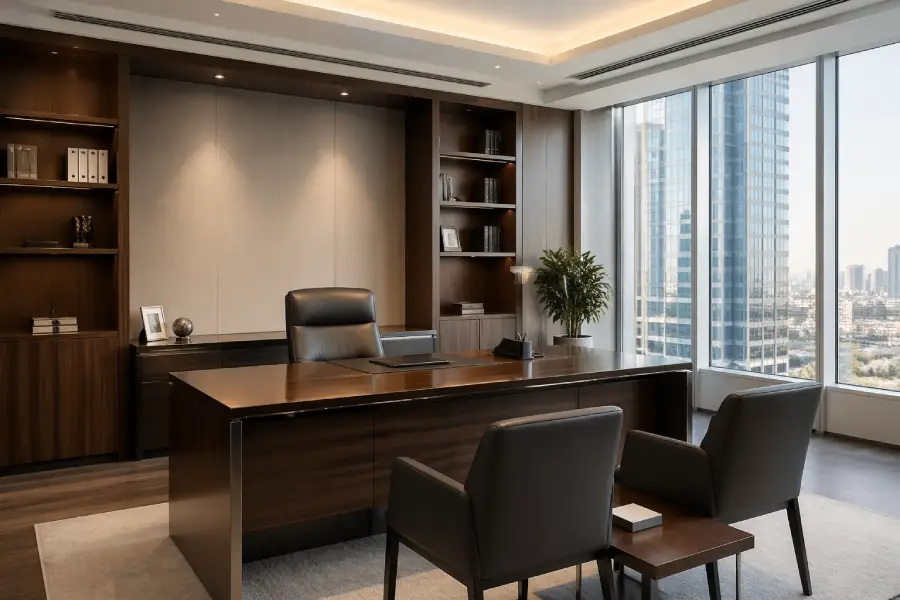
What Is a Private Office?
A private office is a space that is used exclusively by an individual or a small team.
This space usually has walls and doors and is separate from the rest of the work environment.
This means that when you are inside, there is much less disturbance and movement from others.
What kind of work is it suitable for?
A private office is perfect for work that requires deep focus.
Like programming, writing, data analysis, or strategic work.
It is also a better choice for sensitive meetings, important calls, or tasks that involve confidential information.
Management teams or roles that have key decision-making roles also usually work more comfortably in this space.
Benefits:
The most important advantage of a Private Office or office cubicle is higher concentration. There are fewer distractions, and you can work more deeply and with higher quality.
Privacy is also a serious advantage.
Your calls, meetings, and even your thinking will take place in a safer space.
There is also more control over the environment, and you can adjust the lighting, sound, and even the temperature of the space to your liking.
For many people, this space creates a sense of calm and greater professionalism, which has a positive effect on the quality of work.
Limitations
Instead, communication with the rest of the team becomes less.
There may be fewer of the quick, spontaneous interactions that happen in Open Office.
The cost is also usually higher, as a separate space is required for each person or small team.
Sometimes people distance themselves from the overall team atmosphere and become less involved in daily tasks.
If not balanced, this model can create a sense of isolation, especially for those who need daily interaction.
You Might Also Enjoy: Top 12 Considerations for a New Office Plan
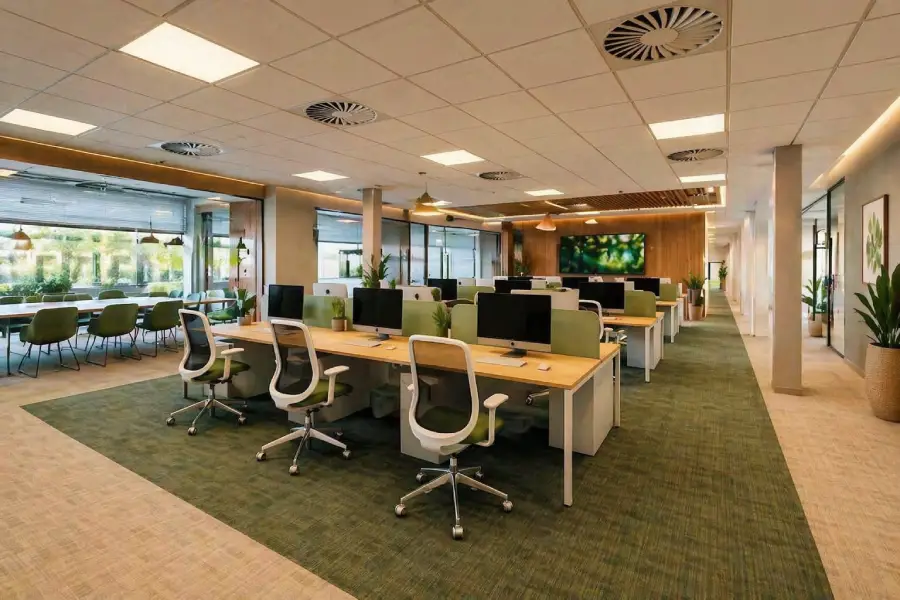
What Is an Open Space Office?
Open Office or Open Space Office refers to a work environment that does not have walls or separate rooms, or is very limited.
People work in a shared space, and desks are usually located next to each other.
This model is designed to make communication easier, and people interact faster.
In this space, you see your colleagues, hear their voices, and access to them is faster.
The main goal is to reduce the distance between people and increase collaboration.

Benefits:
The biggest advantage of Open Office is fast and convenient interaction.
If you have any questions or need to coordinate, there is no need to email or schedule a formal meeting.
Often, a short conversation moves things forward.
This model is very useful for teamwork, especially teams like marketing, sales, or design that collaborate constantly.
Ideas are exchanged more easily, and decisions are made faster.
It is also usually more cost-effective because it requires less space per person and has a simpler design.
For startups or growing companies, this is a serious advantage.
It is also usually more cost-effective because it requires less space per person and has a simpler design, including more flexible use of modern office furniture.
Limitations
The biggest challenge with Open Office is distraction.
Noise, traffic, and conversations around you can make it difficult to concentrate.
For tasks that require deep focus, this becomes a real problem.
Privacy is also limited, and if you want to make an important call or work on a sensitive topic, you have fewer options.
This can affect the quality of some work.
Another issue is mental fatigue.
When you are constantly exposed to sound and interaction, the brain doesn’t have a chance to rest.
Over time, this can lead to reduced productivity, especially when combined with long hours at your desk and an uncomfortable office chair.
In some cases, too much communication causes constant interruptions instead of helping.
This means that people are constantly engaged in talking and coordinating rather than doing deep work.
For this reason, Open Office is not suitable for all types of work and, if used without the program, can cause more problems than benefits.

You Might Also Enjoy: Home Office Design Ideas in 2026: Ultimate Guide for Productivity & Style
When a Private Office Is Better
Private Office is best when focus, privacy, and control of the environment are more important than quick interaction.
- Confidential work: For working with sensitive information such as contracts, internal data, or financial matters, a private space provides greater security.
- Deep focus tasks: For tasks like programming, writing, or data analysis, the absence of distractions helps maintain focus.
- Leadership roles: Managers need a quiet, uninterrupted space to make decisions and plan.
- Legal / Finance / Healthcare / HR: These areas deal with sensitive information and require high privacy.
- Client meetings and calls: A quiet, private space makes calls and meetings more professional and undisturbed.
Overall, Private Office is suitable for tasks where the quality of focus and information security are more important than the speed of interaction.
When an Open Office Is Better
Open Office is best when speed of communication, teamwork, and flexibility are more important than privacy.
This space is designed for interactive work.
- Collaborative teams: If your work depends on constant communication with colleagues, Open Office is a great help.
Questions are answered quickly, and coordination is easier.
- Startups: Startups usually change quickly and require agility.
Open Office brings teams closer together and makes decisions faster.
- Creative / project-based teams: Design, marketing, or product teams need constant ideation.
Open spaces make conversations easier to form, and ideas are more quickly exchanged.
- Fast communication: If your work requires quick decision-making, Open Office is useful.
Many arrangements are made without a formal meeting and with just a short conversation.
- Lower cost/space efficiency: Open Office is usually cheaper and uses space better.
For growing companies or teams with limited budgets, this is a significant advantage.
The Real Winner for Most Companies: A Hybrid Office Layout
For most companies, the main issue is not whether Open Office or Private Office is better.
The problem is that each one only covers one type of need.
For this reason, the Hybrid Office Layout has become a more practical choice.
Because it designs the space based on the type of work, not a fixed model.
Open collaboration zones
These spaces are designed for teamwork and rapid interaction, where people come together to brainstorm, coordinate, and solve problems quickly.
Their main advantage is the speed of communication.
But they are not suitable for deep focus and are more used for everyday group work.
Private focus rooms
These rooms are for tasks that require high focus.
Here, distractions are reduced, and one can work for long periods of time without interruption
The important thing is that these spaces are complementary, not a replacement for an office desk.
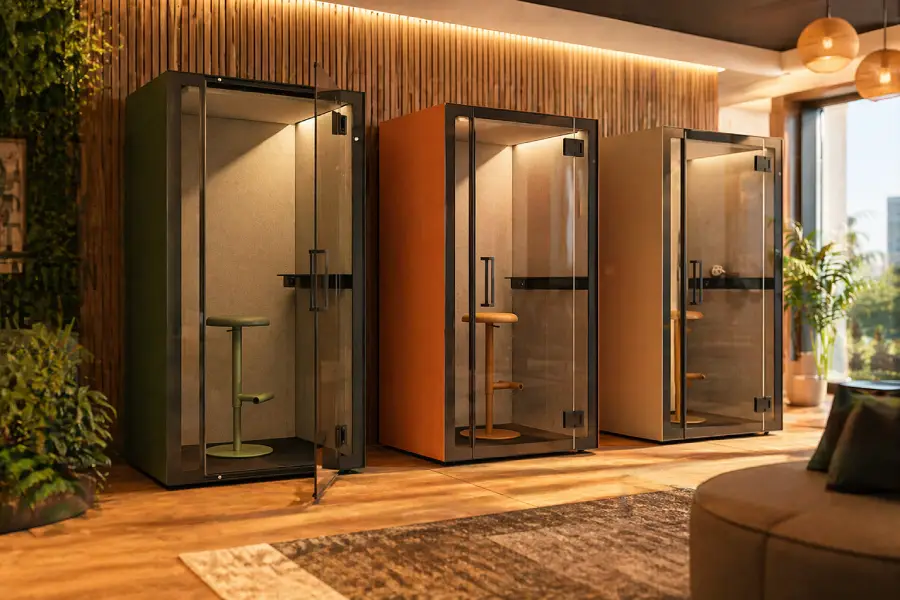
Phone booths
They are used for short calls and video calls, and are especially useful in crowded environments.
Phone booths help maintain privacy and prevent other people from being disturbed by noise.
Huddle rooms
Small rooms for quick, multi-person meetings, typically used for quick decision-making or project coordination.
These spaces help conversations move away from the crowded and public, without making them formal.
They are very effective for speeding up teamwork.
Bookable meeting rooms
Formal meeting rooms that are reserved are used for important meetings, presentations, or client meetings.
These spaces create order and allow meetings to be held without distractions and with high focus.
Overall, Hybrid Office is successful because it gives every type of work a suitable space.
Rather than forcing everyone to work in the same style, it strikes a balance between focus, engagement, and flexibility.
You Might Also Enjoy: Does My Business Need Contract Office Furniture?
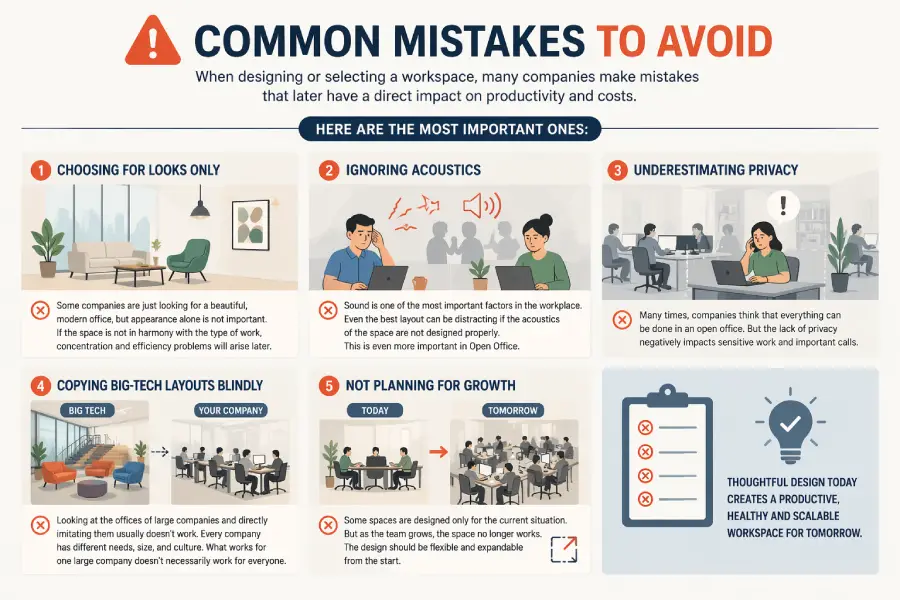
Common Mistakes to Avoid
When designing or selecting a workspace, many companies make mistakes that later have a direct impact on productivity and costs.
Here are the most important ones:
Choosing for looks only
Some companies are just looking for a beautiful, modern office, but appearance alone is not important.
If the space is not in harmony with the type of work, concentration and efficiency problems will arise later.
Ignoring acoustics
Sound is one of the most important factors in the workplace.
Even the best layout can be distracting if the acoustics of the space are not designed properly.
This is even more important in Open Office.
Underestimating privacy
Many times, companies think that everything can be done in an open office.
But the lack of privacy negatively impacts sensitive work and important calls.
Copying big-tech layouts blindly
Looking at the offices of large companies and directly imitating them usually doesn’t work.
Every company has different needs, size, and culture.
What works for one large company doesn’t necessarily work for everyone.
Not planning for growth
Some spaces are designed only for the current situation.
But as the team grows, the space no longer works.
The design should be flexible and expandable from the start.
Conclusion
Ultimately, there is no single, definitive answer to the question “Private Office vs Open Office: What Is Better for Productivity, Privacy, and Cost?”
If your work depends on deep focus, confidential information, and important meetings, Private Office is a more logical choice.
If speed of communication, teamwork, and flexibility are more important to you, Open Office may perform better.
But in practice, most companies get the best results with a hybrid office layout.
Because this model allows each type of work to be done in the right space—supporting focused work, collaboration, and meetings.
The simple conclusion is this: The best office layout is not the one that is “trendy,” but the one that aligns with the real needs of your team.

John Ofield is a recognized expert in the office furniture and office cubicle industry in Houston, TX, with over 40 years of experience. As the founder of ROSI Office Systems, he specializes in furniture space planning, custom cubicle designs, modern office chairs and tables, and high-quality commercial furniture. John’s expertise helps businesses enhance productivity and collaboration. He is also dedicated to mentoring entrepreneurs and redefining workspaces to inspire success.